
2025 Year-End Individual Tax Planning
As the end of the year approaches, it’s the perfect time to take a proactive look at your finances and tax situation. Strategic year-end tax planning can help you minimize your tax liability, take advantage of available deductions and credits, and set yourself up for a stronger financial future. Whether you’re an employee, business owner, or managing family finances, understanding the steps you can take before December 31st can make a significant difference when it’s time to file your return. In this article, we’ll break down practical tax planning tips and financial moves you can make now to maximize your savings and boost your peace of mind for the year ahead. This is intended to serve only as a general guideline. Your personal circumstances will likely require careful examination
Itemized Deductions
The TCJA suspended several itemized deductions for 2018 through 2025 while boosting the standard deduction. The OBBBA generally extends these rules with some modifications.
YEAR-END MOVE: If you expect to itemize deductions on your 2025 tax return, take advantage of several key deductions that can lower your tax bill. Consider the following:
- Donate cash or property to a qualified charitable organization (see more below).
- Pay deductible mortgage interest if it makes sense for your situation. This includes interest on acquisition debt up to $750,000 for your principal residence and one other home.
- Make state and local tax (SALT) payments up to the annual deduction limit. Under the OBBBA, the SALT cap is quadrupled from $10,000 to $40,000 for 2025, subject to a phase-out for high-income taxpayers. The cap increases by 1% annually through 2029 before expiring.
- Do home improvements that qualify for mortgage interest deductions as acquisition debt. This includes loans made to substantially improve a qualified residence.
- Schedule non-emergency physician or dentist visits like exams or cleanings in 2025 if you expect to qualify for a medical deduction this year. Only unreimbursed expenses above 7.5% of your adjusted gross income (AGI) are deductible.
Tip: Conversely, if you do not expect to qualify for a medical deduction in 2025, absent other circumstances you might as well delay non-emergency expenses to 2026 when they might do you some tax good.
Charitable Donations
The tax law allows you to deduct charitable donations within generous limits if you meet certain recordkeeping requirements. But the OBBBA adds several tax complications.
YEAR-END MOVE: Bunch charitable donations in a year in which you expect to itemize. For instance, if you are itemizing in 2025, you may step up charitable gift-giving before January 1. As long as you make a donation this year, it is deductible in 2025—even if you charge it in December 2025 and pay it in 2026.
For the first time ever, the OBBBA imposes a floor of 0.5% of AGI before you can claim any charitable deduction, effective in 2026. This new rule may be especially important if you are planning to donate appreciated long-term gain property that would qualify for a deduction equal to the property’s fair market value (FMV). The deduction for property is limited to 30% of AGI, but any excess may be carried over for up to five years.
Tip: The OBBBA also allows a deduction of up to $1,000 for non-itemizers, beginning in 2026. The maximum deduction is doubled to $2,000 on a joint return.
Home Energy Credits
If you own your principal residence, you may benefit from two types of “home energy” tax credits on your 2025 return.
YEAR-END MOVE: Make energy-saving installations before the end of the year to secure credits for qualified improvements. Under the OBBBA, both credits will expire after 2025 and are not expected to be renewed. So, it is now or never!
The two credits still available before 2026 are as follows:
- Energy Efficient Home Improvement Credit: This is a 30% credit for qualified expenses like insulation, central air conditioners, water heaters, furnaces, heat pumps, biomass stoves and boilers and home energy audits, up to a maximum of $3,200.
- Residential Clean Energy Credit: This is a 30% credit for the cost of new qualified clean energy property like solar electric panels, solar water heaters, wind turbines, geothermal heat pumps, fuel cells and battery storage technology.
Tip: Other special rules and limits may apply to certain qualified expenses. Obtain confirmation of tax breaks before making any commitments.
Alternative Minimum Tax
The alternative minimum tax (AMT) calculation features technical adjustments, inclusion of “tax preference items” and subtraction of an exemption amount, subject to a phase-out. After comparing AMT liability to regular tax liability, you effectively pay the higher of the two.
YEAR-END MOVE: Have your tax professional assess your AMT status. When it makes sense, you may shift certain income items to 2026 to reduce AMT liability for 2025. For instance, you might postpone the exercise of incentive stock options (ISOs) that count as tax preference items.
Due to changes in the TCJA and other legislative modifications, the exemption amounts for the AMT have increased steadily in recent years, as shown below.

The OBBBA permanently establishes a favorable exemption phase-out threshold of $500,000 for single filers and $1 million for joint filers, with inflation indexing, beginning in 2026. However, the new law also doubles the rate for phasing out exemptions.
Tip: The AMT has only two tax rates: 26% and 28%. If you are sure that you will have to pay the AMT in 2025 and your top AMT rate is lower than your top regular rate—for example, the highest rate of 37%—-you might accelerate income into 2025.
Family Tax Breaks
If you are a parent with young children, you may be entitled to several tax breaks designed to reduce your family’s tax burden.
YEAR-END MOVE: Maximize the tax benefits for your situation This may comprise one or more of the following tax provisions generally enhanced by the OBBBA.
- For 2025, parents may claim a Child Tax Credit (CTC) of $2,200 for each qualifying child, subject to a phase-out beginning at $200,000 for single filers and $400,000 for joint filers.
- The dependent care credit is enhanced for certain taxpayers with a modified adjusted gross income (MAGI) below specified levels. For high-income taxpayers, the maximum credit remains $600 for one child and $1,200 for two or more children.
- Previously, the adoption credit was 100% nonrefundable. Beginning in 2025, the new law provides that up to $5,000 of the credit is refundable, indexed for inflation in the future.
- Under the TCJA, parents could withdraw up to $10,000 tax-free from a Section 529 plan for higher education to pay a child’s tuition at a qualified elementary or secondary school. The OBBBA doubles the cap to $20,000, beginning in 2026.
Tip: The maximum annual amount that can be contributed to a flexible spending account (FSA) for dependent care expenses increases from $5,000 to $7,500, beginning in 2026.
Miscellaneous
- Take out a car loan. The OBBBA allows annual deductions of up to $10,000 of interest on loans for qualified vehicles for 2025 through 2028, subject to a phase-out beginning at $100,000 of MAGI for single filers and $200,000 for joint filers.
- Pay tuition in 2025 for a child’s semester beginning in early 2026 if you can claim one of two higher education credits. However, both credits are subject to phase-outs based on MAGI.
- Avoid an estimated tax penalty with a safe-harbor exception. Generally, a penalty will not be imposed if you pay 90% of your current year’s tax liability or 100% of your prior year’s tax liability (110% if your AGI exceeded $150,000).
- Empty out FSAs for health care or dependent care expenses if you will forfeit unused funds under the “use-it-or-lose it” rule. However, your employer’s plan may provide a carryover to 2026 of up to $660 of unused funds or a 2½-month grace period.
- If you own property damaged in a federal disaster area in 2025, you may elect to obtain fast tax relief by filing an amended 2024 return. The TCJA suspended the deduction for casualty losses for 2018 through 2025 but retained a current deduction for federal disaster-area losses. The OBBBA extends this tax break and allows deductions for losses in state-declared disaster areas, beginning in 2026.
Capital Gains and Losses
Investors can manage sales of assets like securities at year-end to maximize tax benefits. First, capital gains and losses offset each other. If you show an excess loss for the year, you can offset up to $3,000 of ordinary income before any remainder is carried over to next year. Long-term capital gains from sales of securities owned longer than one year are taxed at a maximum rate of 15% or 20% for high-income investors. Conversely, short-term capital gains are taxed at ordinary income rates reaching 37%. The OBBBA preserves these tax rates for 2026 and beyond.
YEAR-END MOVE: Review your portfolio. Depending on your situation, you may “harvest” capital losses to offset gains, especially high-taxed short-term gains, or realize capital gains that will be partially or wholly absorbed by losses.
Be aware of even more favorable tax treatment for certain long-term capital gains. Notably, a 0% rate applies to taxpayers below certain income levels, such as young children. Furthermore, some taxpayers who ultimately pay ordinary income tax at higher rates due to their investments may qualify for the 0% tax rate on a portion of their long-term capital gains.
However, watch out for the “wash sale rule.” If you sell securities at a loss and reacquire substantially identical securities within 30 days of the sale, the tax loss is disallowed. One way to avoid this adverse result is to wait at least 31 days to reacquire substantially identical securities.
Note: A disallowed loss increases your basis for the securities you acquire and could reduce taxable gain on a future sale.
Tip: The preferential tax rates for long-term capital gains also apply to qualified dividends. These are most dividends paid by U.S. companies or qualified foreign companies.
Net Investment Income Tax
When you review your portfolio (see above), do not forget to account for the 3.8% “net investment income tax” (NIIT). The NIIT applies to the lesser of “net investment income” (NII) or the amount by which MAGI for the year exceeds $200,000 for single filers or $250,000 for joint filers. (These thresholds are not indexed for inflation.) The definition of NII includes interest, dividends, capital gains and income from passive activities, but not Social Security benefits, tax-exempt interest and distributions from qualified retirement plans and IRAs.
YEAR-END MOVE: Have an estimate made of your potential liability for 2025. Depending on the results, you may be able to reduce the tax on NII or avoid it altogether.
For example, you may invest in municipal bonds (“munis”). The interest income from munis does not count as NII, nor is it included in the MAGI calculation. Similarly, if you turn a passive activity into an active business, the resulting income may be exempt from the NIIT.
Tip: When you add the NIIT to your regular tax, your effective overall tax rate could exceed 40%—50% for residents in some states. Factor this into your investment decisions.
Required Minimum Distributions
Generally, you must begin taking “required minimum distributions” (RMDs) from qualified retirement plans, like 401(k) plans, and IRAs after a specified age. Under SECURE 2.0, the age threshold has been raised to 73 (scheduled to increase to 75 in 2033). The amount of the RMD is based on IRS life expectancy tables and your account balance at the end of last year.
YEAR-END MOVE: Assess your obligations. If you can postpone RMDs longer, you can continue to benefit from tax-deferred growth. Otherwise, make arrangements to receive RMDs before January 1, 2026, to avoid any penalties.
Conversely, if you are still working and do not own 5% or more of a business with a qualified plan, you can postpone RMDs from that plan until your retirement. This “still working exception” does not apply to RMDs from IRAs or qualified plans of other employers.
Previously, the penalty for failing to take timely RMDs was equal to 50% of the shortfall. SECURE 2.0 cuts the penalty in half to 25% (10% if corrected in a timely fashion).
Tip: Beneficiaries of qualified plans and IRAs must also comply with RMD rules. If you are a nonspouse beneficiary, you are generally required to empty out the account over ten years.
401(k) Plan Savings
Contributions to a 401(k) plan are made by employees on a pre-tax basis and can earn tax-deferred income until withdrawals are made. Plus, your company may provide “matching contributions” based on a percentage of salary.
YEAR-END MOVE: Step up contributions to feather your 401(k) nest egg. In fact, if you have cleared the Social Security wage base of $176,100 in 2025, you can allocate some or all of the payroll tax savings to extra 401(k) contributions without reducing take-home pay.
For 2025, the regular contribution limit is $23,500, but if you are 50 or older you can add a “catch-contribution” of $7,500 for a total of $31,000. Even better: Under SECURE 2.0, those age 60 through 63 can make a “super catch-up contribution” of $11,250 for a total of $34,750.
Beginning in 2026, if individuals age 50 and over earned more than $145,000 in the prior year, any of their 401(k) catch-up contributions must be made to a Roth-type account.
Tip: The Roth version of the 401(k) imposes tax on amounts contributed in 2025, but future payments are generally exempt from tax.
Estate and Gift Tax
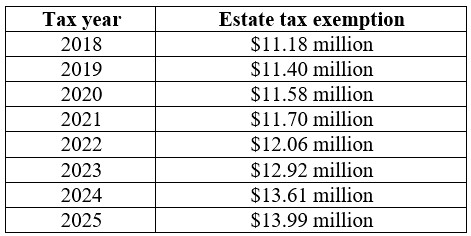
Due to a series of laws ending with the TCJA, the federal estate and gift tax exemption has gradually increased from $1 million to $10 million, indexed for inflation. For decedents dying in 2025, it is $13.99 million. However, the exclusion was scheduled to revert to $5 million, plus indexing, in 2026. Now the OBBBA has permanently increased the exclusion to $15 million in 2026 with indexing. The exclusion amounts dating back to the TCJA are shown below.
YEAR-END MOVE: Adjust your estate plan as needed. For instance, your plan may involve various techniques, including trusts, that maximize the benefits of the estate tax exemption.
Furthermore, you can reduce the size of your taxable estate through lifetime gifts. Thanks to the annual gift tax exclusion, you can give each recipient up to $19,000 in 2025 without any gift tax liability. Thus, a couple can effectively give tax-exempt gifts up to $38,000 per recipient.
Tip: You may “double up” by giving gifts in both December and January that qualify for the annual gift tax exclusion for 2025 and 2026, respectively.
Miscellaneous
- *Minimize “kiddie tax” problems by having your child invest in tax-deferred or tax-exempt securities. For 2025, unearned income above $2,700 that is received by a dependent child under age 18 (or under age 24 if a full-time student) is taxed at the top tax rate of the parents.
- *If you rent out your vacation home, keep your personal use within the tax law limits. No loss deduction is allowed if your personal use exceeds the greater of 14 days or 10% of the rental period.
- *From a tax perspective, it is often beneficial to sell mutual fund shares before the fund declares dividends (the ex-dividend date) and buy shares after the date dividends are declared.
- *Sell real estate on an installment basis. For payments over two years or more, you can defer tax on a portion of the sales price. Also, this may effectively reduce your overall tax liability.
- *Consider a qualified charitable distribution (QCD). If you are age 70½ or older, you can transfer up to $108,000 of IRA funds directly to charity in 2025, free of tax (but nondeductible). SECURE 2.0 authorizes a one-time transfer of up to $54,000 to a charitable remainder trust (CRT) or charitable gift annuity (CGA) as part of a QCD.
- *Weigh the benefits of a Roth IRA conversion, especially if this will be a low-tax year. Although the conversion is subject to current tax, you generally can receive tax-free distributions in retirement, unlike taxable distributions from a traditional IRA.
CONCLUSION
This year-end tax-planning article is based on the prevailing federal tax laws, rules and regulations. Of course, it is subject to change, especially if additional tax legislation is enacted by Congress before the end of the year.
Finally, remember that this is intended to serve only as a general guideline. Your personal circumstances will likely require careful examination. We would be glad to schedule a meeting with you to assist with all your tax-planning needs.
To review year-end tax planning for businesses, please click here!
This year-end tax-planning article is published for our clients, friends and professional associates. It is designed to provide accurate and authoritative information with respect to the subject matter covered. The information contained in this letter is not intended or written to be used for the purpose of avoiding any penalties that may be imposed under federal tax law and cannot be used by you or any other taxpayer for the purpose of avoiding such penalties. Before any action is taken based on this information, it is essential that competent, individual, professional advice be obtained.